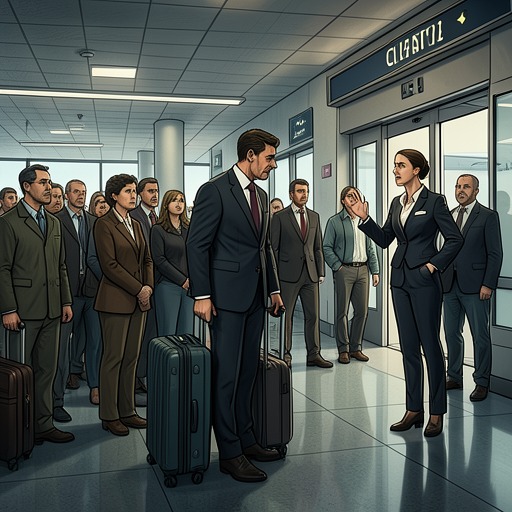
Travis declines the Sharks coaching job
The Journey CollectionTravis declines the Sharks coaching job at the decisive point where his professional identity as a quarterback collides with his newly recognized responsibilities to Penelope Stone and Max. The refusal is not simply a rejection of employment. It is the action through which Travis accepts that his life has moved beyond the Miami Sharks and that returning to Texas, even at the cost of football, is the future he is willing to defend.
Causes and Background
The offer arises from a career crisis made public before Travis can control its meaning. After six seasons with the Miami Sharks, repeated injuries leave him on the reserved list, and the team does not expect him to return for the rest of the season. Tamara Roberts’s television report turns the injury into a question about whether he will ever recover, while later coverage states that his shoulder is not strong enough for him to play again. The medical and organizational judgment therefore precedes Travis’s decision: he is no longer being asked merely to wait for a comeback, but to imagine a life in which playing is finished.
The pressure is intensified by the public status he has accumulated. During the flight from Miami to Amarillo, fans ask him to autograph newspapers, magazines, and even barf bags, reminders that the quarterback exists simultaneously as a worker and as a celebrity. The Miami Sharks had come within one game of a national championship the previous season and were favored to win the next one, making Travis’s absence feel like a public loss as well as a private one. News reports repeatedly frame his departure as a story of injury, failure, or possible replacement, while Travis experiences it as a decision whose most important reasons are not visible to reporters.
The Offer and Refusal
Stewart Thornton, the owner of the Sharks, calls Travis at home in Texas. Travis initially fears that the call will announce a trade or a release, but Stewart explains that he, Coach Johnson, and Cal have concluded that Travis’s ability to play has been compromised. Their alternative is a coaching position: with Jerry gone, they want Travis to become the new special teams coach. The proposal recognizes his football knowledge while also confirming that the organization no longer sees him as an active player.
Travis refuses before Stewart can discuss the salary. The decision is painful enough that Max runs outside after hearing it, and Penelope Stone follows him, leaving Travis to face the call alone. Stewart warns that another offer may never come, but Travis answers that people in Texas are counting on him and that he cannot let them down again. When Stewart points out that Travis has not even heard how much the job would pay, Travis makes the basis of his choice explicit: money will not change his mind. The scene converts retirement from something imposed by an injured shoulder into an act of allegiance to a different set of obligations.
Football, Family, and Identity
In Stewart’s office, Travis explains that football has been his life since childhood. He once dreamed of standing in the world’s largest stadium while crowds chanted his name and even slept with his football. He acknowledges that his six-year career was successful, with more wins than losses, but insists that he cannot continue. The crucial discovery occurred when he returned home to settle matters before deciding what came next. In Texas, he found a family and people who love and need him, including Penelope Stone and Max.
That explanation places the refusal within a larger identity transformation. Travis does not deny the value of professional football or pretend that leaving is effortless. He admits that he wanted the chance to lead the Sharks to the championships and recognizes Malcolm Rollins as a promising young player capable of guiding the team in his absence. Yet the hierarchy of meaning has changed. Football remains the source of his fame, discipline, and memories, but it no longer has the right to determine where he belongs. His decision shifts professional capital toward family responsibility rather than toward the coaching role that would have preserved his connection to Miami.
Public Narrative and Private Decision
The Sharks’s media environment repeatedly contests Travis’s account. Tamara Roberts reports that he is leaving after turning down the special teams position and contrasts his departure with Malcolm Rollins’s apparent readiness to lead the team. She also links his decision to the shoulder injury and Stewart Thornton’s refusal to clear him to play. At the airport, a fan recognizes Travis, praises his victory over Chicago, and then assumes that he simply could not get over his last hit. Travis is uncomfortable as strangers interpret his retirement through the most marketable football explanation.
The newspaper coverage offers little relief. At the airport bookstore, Travis sees his photograph on the front page beneath Tamara Roberts’s byline and finds that it repeats the same information already circulating through television and other papers. He brings the paper back to Russ McCoy and remarks that the media are determined to make more of his departure than it contains. The contrast is central to the action: public narratives reduce the event to injury, roster status, and spectacle, whereas Travis’s private account gives it a relational cause. He is leaving because his future is in Texas, not because the media have successfully explained him.
Consequences and Significance
The refusal closes Travis’s professional football career while opening the possibility of a different role in education and family life. The book later returns to him as an eighth-period History teacher, where the classroom is normally a place of comfort even though he is distracted by somewhere more important. That later image gives the earlier refusal a concrete consequence: Travis’s life is no longer organized around the stadium, the roster, or the next championship, but around a local future in which he can remain present for the people who depend on him.
The action also strengthens his relationship with Max. Max has already asked when Travis intended to reveal that he is his father, forcing the hidden relationship into direct speech. Russ McCoy, in turn, offers to make more effort to support the team if Max will call him Russ, and Max counters by asking to call him Gramps. At the stadium, Max identifies the first visit with his own father as a family tradition, echoing Travis’s memory of first loving football while watching the Broncos win a title with Russ. These recognitions explain what the Sharks position would have cost: it might have preserved Travis’s place in professional football, but it would have pulled him away from the newly formed chain of fatherhood and family belonging. Travis therefore chooses not the easier retirement, but the more demanding return home.